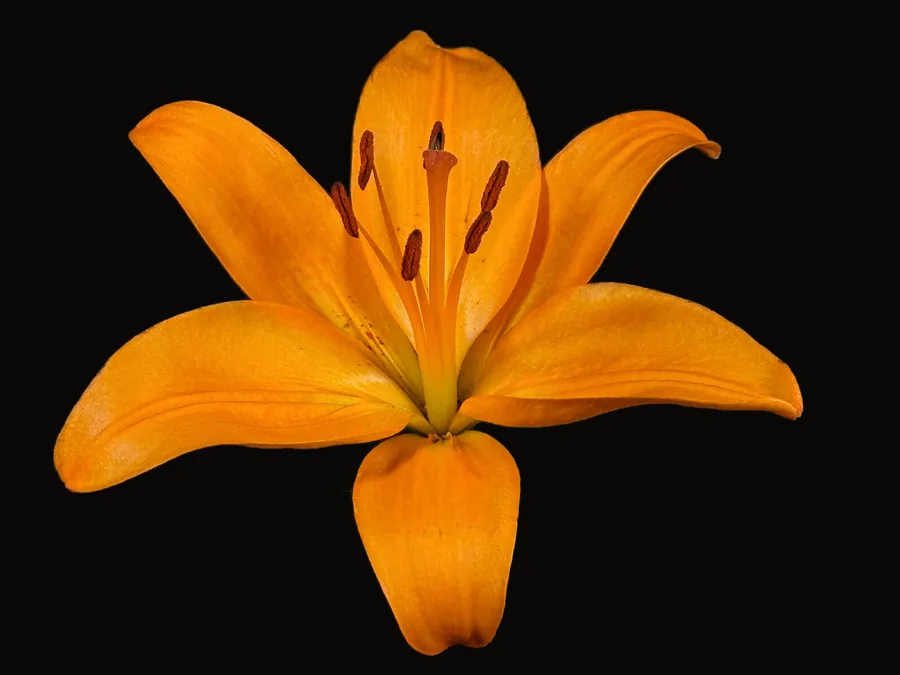
How many petals does a lily have?
None, strictly. A lily has six tepals: three outer and three inner parts that look almost the same, because the plant never split them into separate petals and sepals. Botanists use “tepal” for exactly this case. The six are free from one another and spread or curl back at the tips.
On the stage the outer and inner tepals overlap so closely that, from the front, you cannot tell which is which. Lilies also carry a nectary at the base of each tepal, out of sight in the throat.
What is the difference between a stamen and a pistil?
A stamen is the male part: a thin filament carrying an anther full of pollen. A pistil is the female part: a stigma that catches pollen, a style it grows down through, and an ovary holding the ovules. A lily has six stamens around one central pistil, and both are visible from the front.
In the callouts, 02 and 03 are the stamen (anther and filament). 04, 05 and 06 are the pistil (stigma, style, ovary). Together the two are what the flower is for; the tepals are what it advertises with.
Why do lily anthers swing so freely?
Each anther is attached to its filament at the middle, not at the end, which botanists call versatile. It pivots on the tip like a seesaw, so a visiting insect or a breeze rocks it and shakes pollen free. The pollen is rust-brown and stains fabric, which is why florists often remove the anthers.
Glass makes this hard. Ours are fixed, and we set each at the angle the scan shows, a little off true, as the living ones were.
What does a superior ovary mean?
It means the ovary sits above the point where the other flower parts attach. The tepals and stamens grow from below it, leaving the ovary free of them. In a lily it has three chambers and ripens into a capsule that splits along three seams.
That is why callout 06 points at the throat and not at a visible object. The ovary is behind the point you can see from the front. The scan state shows it as depth: the pistil is the tallest ridge in the middle of the cloud.
How many kinds of lily are there?
The genus Lilium has 119 accepted species, according to the World Checklist of Selected Plant Families. The orange lily here is an Asiatic hybrid, a group bred from species in section Sinomartagon, with medium-sized flowers that face up or outward and mostly have little scent.
Hybrids are harder to name exactly than species, so the specimen record says “Asiatic hybrid” and goes no further.
Sources
- Lilium, Wikipedia — tepal count, the three-celled capsule, 119 species and the Asiatic hybrids.
- Gynoecium, Wikipedia — pistil, ovary, style, stigma, locules and the superior ovary.
- Stamen, Wikipedia — filament, anther and the versatile attachment.