Pontil & Pistil Enquire
Specimen
0417
Plant
Lilium, Asiatic hybrid
Family
Liliaceae
Scale
1 : 1
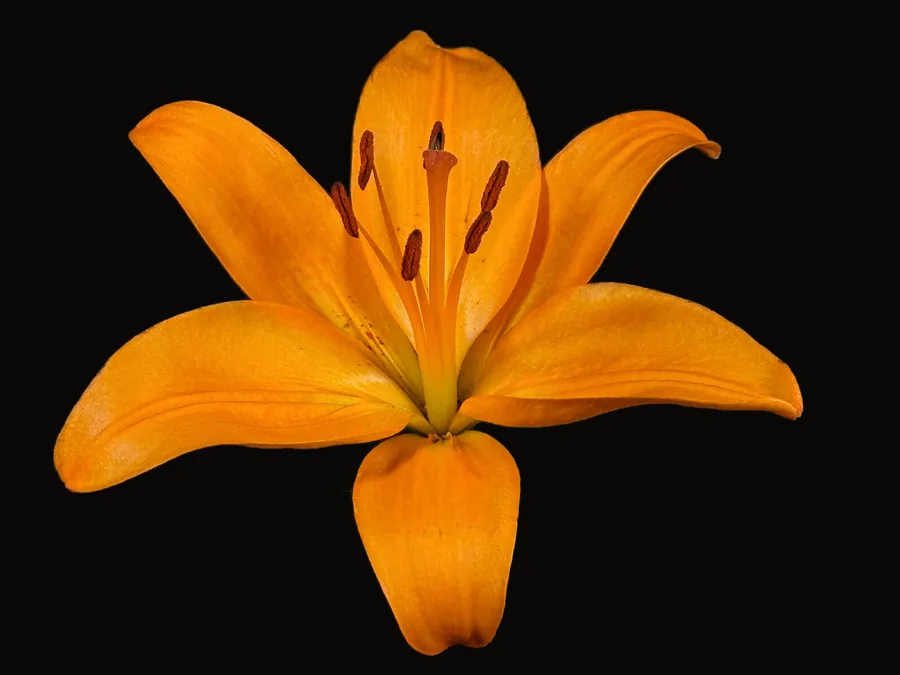
An orange Asiatic lily seen from the front against black: six curved tepals, six rust-brown anthers on thin filaments, and a single pistil rising from the throat.
  1. 01Tepalone of six
  2. 04Stigmathree-lobed tip
  3. 02Antherpollen sac
  4. 03Filamentholds the anther
  5. 05Stylestalk of the pistil
  6. 06Ovarythree chambers, behind this point

Glass botanical models, one bloom at a time

Glass flowers, made from one living bloom.

A lily opens for about a week. We scan it on the first day and spend eleven weeks at the bench making the same flower in glass.

00 — Day 0, 09:40. The bloom opens.

State of the specimen

Specimen 0417, named

Six parts of one flower, named

The numbers match the callouts above. A lily is a good first specimen because it is exact about its own structure: the counts never change from bloom to bloom, only the proportions do. The full anatomy page goes further.

  1. 01

    Tepal

    A lily has no separate petals and sepals. It has six tepals, three outer and three inner, that look almost alike. In glass each is pulled from a single gather and curved by hand.

  2. 02

    Anther

    The pollen sac, fixed to its filament at the middle so it swings freely. Six anthers, rust-brown here, and the pollen stains cloth. Ours are rolled from enamel on a mandrel and left slightly off true, as the real ones are.

  3. 03

    Filament

    The thread that carries an anther into the throat of the flower. Each is a drawn glass rod, finer than a pencil lead, and the thinnest part of the model to survive a shipment.

  4. 04

    Stigma

    The receptive tip of the pistil, three-lobed in a lily and sticky when ripe. It is the last part we fire, because the enamel on it has to stay glossy.

  5. 05

    Style

    The stalk between stigma and ovary. Pollen tubes grow down through it to reach the ovules. In the model it is also the spine the whole centre is built along.

  6. 06

    Ovary

    A superior ovary of three fused chambers. It ripens into a capsule that splits along three seams. It sits behind the throat, out of sight from the front, so the callout points at where it is, not at what you can see.

Eleven weeks

From the day the bloom opens to the day the glass is boxed

The flower is the specimen for about a week. After that, the scan is the specimen. Everything at the bench is checked against the file, and the file is checked against the herbarium sheet.

  1. Cut at anthesis

    We cut the stem as the flower opens, when the anatomy is at its most open and most exact.

  2. Scanned

    212 photographs from fixed angles and one depth pass. After this the file is the reference.

  3. Checked

    A botanist counts every part against the published description and the nearest herbarium sheet, and signs.

  4. At the flame

    Tepals are pulled and curved, filaments drawn, anthers rolled. Each tepal takes three to five passes through the flame.

  5. Fired and boxed

    Enamels are fused, then the model is annealed for 14 hours so it does not crack on a cold morning.

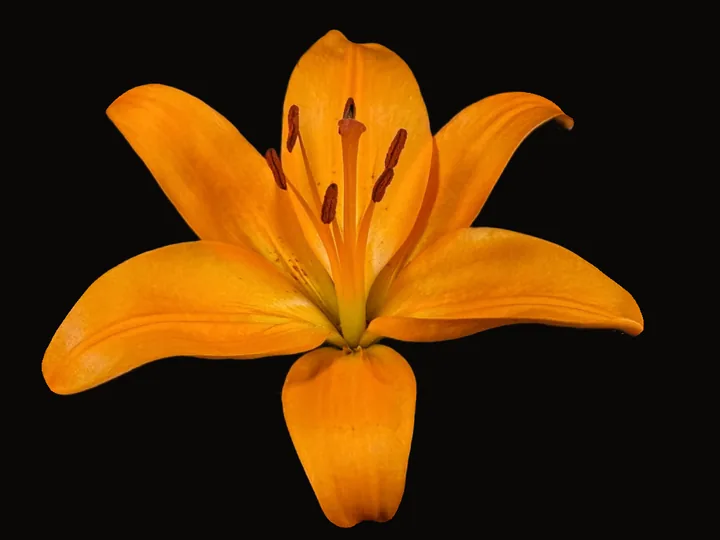
The living lily on black, as photographed on the day it opened.

Day 0, 09:40 · living

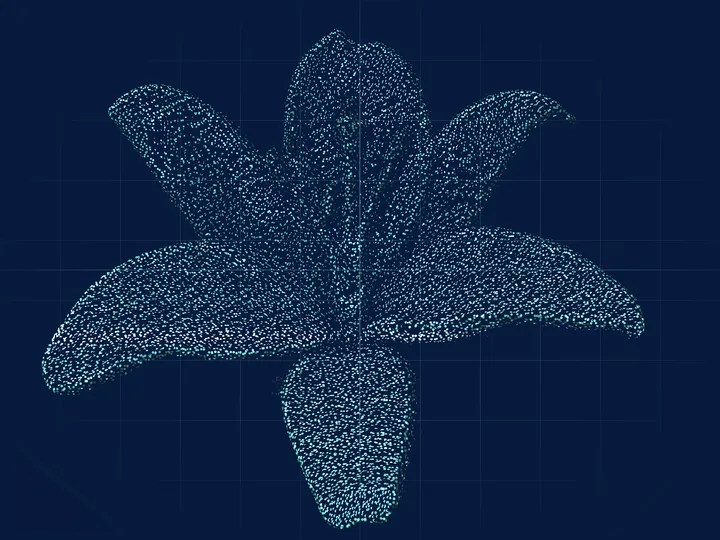
The same lily as a point cloud of cyan-green dots built from its depth map, over a measurement grid.

Day 0, 14:10 · scan

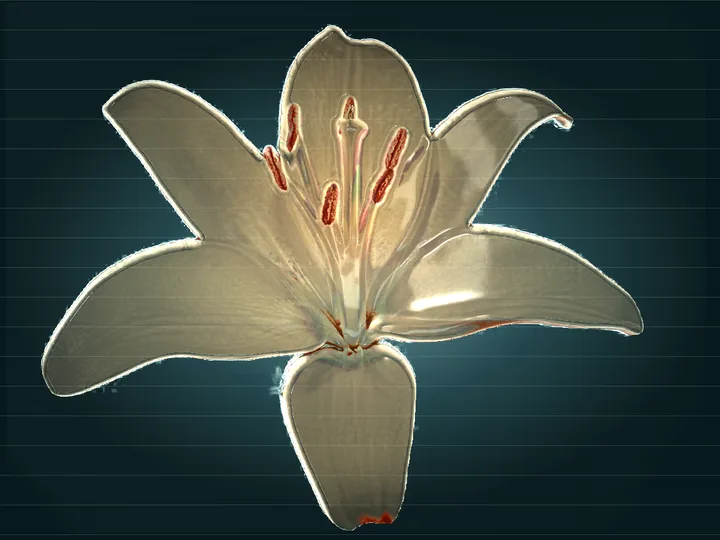
The same lily rendered as pale, mostly clear glass with rust-red enamel anthers, a light rim, and ruled lines behind it, lit from behind.

Week 11 · glass

One bloom, three moments, drawn by the same renderer from the same photograph and depth map.

The cabinet

Four of eight models in progress

Each plant sets its own start date. A hellebore waits for midwinter and a water lily for a warm June, so the cabinet fills in the order the plants flower, not the order we would choose.

Glass models in progress, by specimen number
No.PlantFamilyFlowersBench weeks
0417Lilium, Asiatic hybridLiliaceaeJune–July11
0391Paeonia lactifloraPaeoniaceaeMay–June16
0338Passiflora caeruleaPassifloraceaeJuly–September22
0287Helleborus nigerRanunculaceaeDecember–March10

All eight specimens, with the reason each was chosen

Questions we are asked

Plain answers about glass flowers

The short answer comes first. The longer one follows it.

What are glass flowers?

Glass flowers are life-size botanical models flame-worked from glass, wire and enamel so that every part of a plant can be studied after the real one has wilted. The best known are the 847 life-size models and about 3,000 detail models that Leopold and Rudolf Blaschka made for Harvard between 1887 and 1936.

Sources disagree on totals by a few hundred, depending on whether the detail models are counted. The history page sets out which figures come from where.

How do you make a glass flower from a living one?

We cut one bloom as it opens, photograph it from fixed angles within hours, and extract a depth map. A botanist checks the file against published descriptions. A glassworker then builds each tepal, filament and anther at the flame over about eleven weeks, working from the scan rather than from a drawing.

The bench stage is the same craft the Blaschkas used: glass softened in a flame and shaped by hand, with wire inside the thin parts and enamel for colour.

Why scan the flower instead of copying a drawing?

A drawing records what someone chose to see. A scan records the actual proportions of one bloom, including the asymmetry no two flowers share. We keep the file as the reference for the whole build, because the living flower is gone within days and the glass is checked against it for years.

It also means the model is of a particular flower, not a typical one. That is the point of the “scan” state above: it is the same bloom, held still.

How long does a commission take?

Eleven weeks from the day the bloom is scanned, for a lily. The start date is set by the plant, not by us: a peony or a magnolia flowers once a year, so a commission for either begins when the buds open. We quote each model individually and publish no price list.

Larger and more complex flowers take longer. The passion flower in the cabinet is booked for 22 weeks because of its corona.

Are the models scientifically accurate?

Each model is counted against the species description before any glass is worked: six tepals, six stamens and one three-chambered ovary for a lily. A botanist signs the reference sheet first. Colour is matched to the scanned bloom, and variation within a species is recorded rather than averaged away.

Accuracy here means the counts, the arrangement and the proportions. It does not mean the glass can show what the living flower does, such as scent, movement or the way pollen sheds.

Commission a model

Tell us the plant and the month it flowers

Send a species, or a plant from your own garden, and the season you can supply it. If it is not on our list we will say so and suggest the closest flower we can do well. Enquiries are answered by a person, usually within two working days.

Write to the studio